
A die set rolling around in a drawer is a small problem until a lock ring gets bumped out of position, an expander stem catches on another tool, or you waste five minutes looking for the seating die. If you are asking what organizer fits Hornady dies, the useful answer is not simply “a die organizer.” The right organizer must match the dies you own, the way you set them up, and the storage platform you use.
Most Hornady rifle and pistol die sets use the common 7/8-14 threaded die body, but that does not mean every organizer fits them equally well. Lock-ring diameter, die height, installed Lock-N-Load bushings, and the presence of accessories all affect whether a slot holds the die securely or creates an awkward, loose fit.
What Organizer Fits Hornady Dies?
For standard Hornady reloading dies, look for an organizer with individual pockets sized for 7/8-inch reloading dies with their lock rings installed. That is the practical baseline. A pocket designed only around the threaded body may be too narrow once the lock ring is in place, while a shallow pocket can leave taller rifle dies exposed and easy to knock over.
A purpose-built organizer should support the die around its outside diameter without forcing it into the slot. The die needs to stay upright, be easy to grasp, and come out without disturbing the adjustment. If the organizer uses round pockets, the pocket diameter and depth matter more than the label on the product.
There are two common organizer styles that can work well:
1. Individual die holders store each die upright in a dedicated pocket. They are the best choice for active bench use, quick identification, and keeping adjusted dies separated.
2. Die-box organizers hold the complete factory die box or a compatible storage case. They work well when you prefer to keep each caliber together with shellholders, instructions, spare decapping pins, and other small components.
Neither approach is automatically better. Individual pockets improve access during a loading session. Box-based storage is often better for keeping a larger die collection compact and caliber-specific.
Start With the Die Body, Not the Brand Name
Hornady offers several die types, and an organizer that fits one may not fit another. Standard 7/8-14 dies are the most common, but larger dies are used for some big-bore and specialty applications. Those larger dies need a different pocket size and should not be forced into a standard organizer.
Before choosing storage, identify the outside dimensions that matter in real use: the die body, the installed lock ring, and the overall height with the stem and adjustment hardware in place. The lock ring is usually the widest part of a standard die. An organizer that clears the threads but pinches the ring is not a precision-fit solution.
This is especially relevant if you have replaced factory lock rings, use oversized rings, or have added labels, adjustment knobs, or aftermarket accessories. Small changes can turn a nominal fit into a poor one.
Standard Hornady Dies
Standard full-length sizing dies, neck-sizing dies, seating dies, crimp dies, and many pistol dies generally belong in organizers made for conventional 7/8-14 die bodies. A layout with clearly separated pockets prevents metal-on-metal contact and keeps the dies arranged in the order you use them.
For most reloaders, a four-, six-, or eight-die layout makes more sense than a large universal bin. It leaves room for the dies in the set while allowing a dedicated spot for a powder-through expander, taper crimp die, factory-style crimp die, or other caliber-specific tool.
Hornady Lock-N-Load Bushings
Hornady Lock-N-Load bushings change the storage question slightly. The bushing adds width at the top of the die and may add height depending on the organizer orientation. If you leave the bushing installed, choose a holder with enough clearance above and around the die to prevent interference.
Do not assume a standard die tray will accommodate dies with bushings attached. Some upright pocket organizers support the die body below the bushing and leave the upper section open, which is ideal. Others use a close-fitting top plate or shallow compartment that can contact the bushing when the case is closed.
If you remove bushings before storage, a separate labeled compartment for them is worth having. Loose bushings are easy to mix between calibers, and a missing bushing becomes a needless interruption when the press is ready to run.
Larger Hornady Dies and Specialty Tooling
Large-format dies do not belong in a standard 7/8-inch die organizer simply because the organizer happens to have an empty slot. Forcing a larger die into a tight pocket can damage the organizer, scratch the die finish, or make retrieval frustrating.
The same principle applies to specialty dies with longer stems, micrometer seating assemblies, or unusual external geometry. Measure first, then select an organizer built around that footprint. A precision-fit holder should protect the tool and preserve a clean workflow, not require you to remove components every time you put the die away.
Decide Whether You Store Dies Adjusted
The best organizer for Hornady dies depends heavily on whether your dies stay adjusted between loading sessions. If you leave the lock ring set for a specific press and cartridge, upright dedicated storage is usually the better option. Each die can return to the same pocket without loosening the ring or contacting other tools.
If you reset dies frequently, store several calibers in their original boxes, or travel with a compact reloading setup, die-box storage can be more practical. It groups the full set and associated parts together. The trade-off is slower access when you are actively loading and less visibility at a glance.
For adjusted dies, avoid storage methods that place tools on their sides in a common drawer. It may save space, but it also makes it easier for stems, lock rings, and die mouths to contact one another. A dedicated slot keeps each tool where it belongs.
Match the Organizer to Your Storage Platform
A bench organizer and a portable case insert solve different problems. Your bench needs fast, repeatable access. A portable system must also handle movement, vibration, and the occasional hard set-down.
For a fixed reloading bench, an open-top holder is usually the most efficient. Arrange dies by caliber and process order: sizing, expanding or neck-sizing, seating, then crimping. That sequence reduces mistakes and makes it obvious if a tool is missing before you begin.
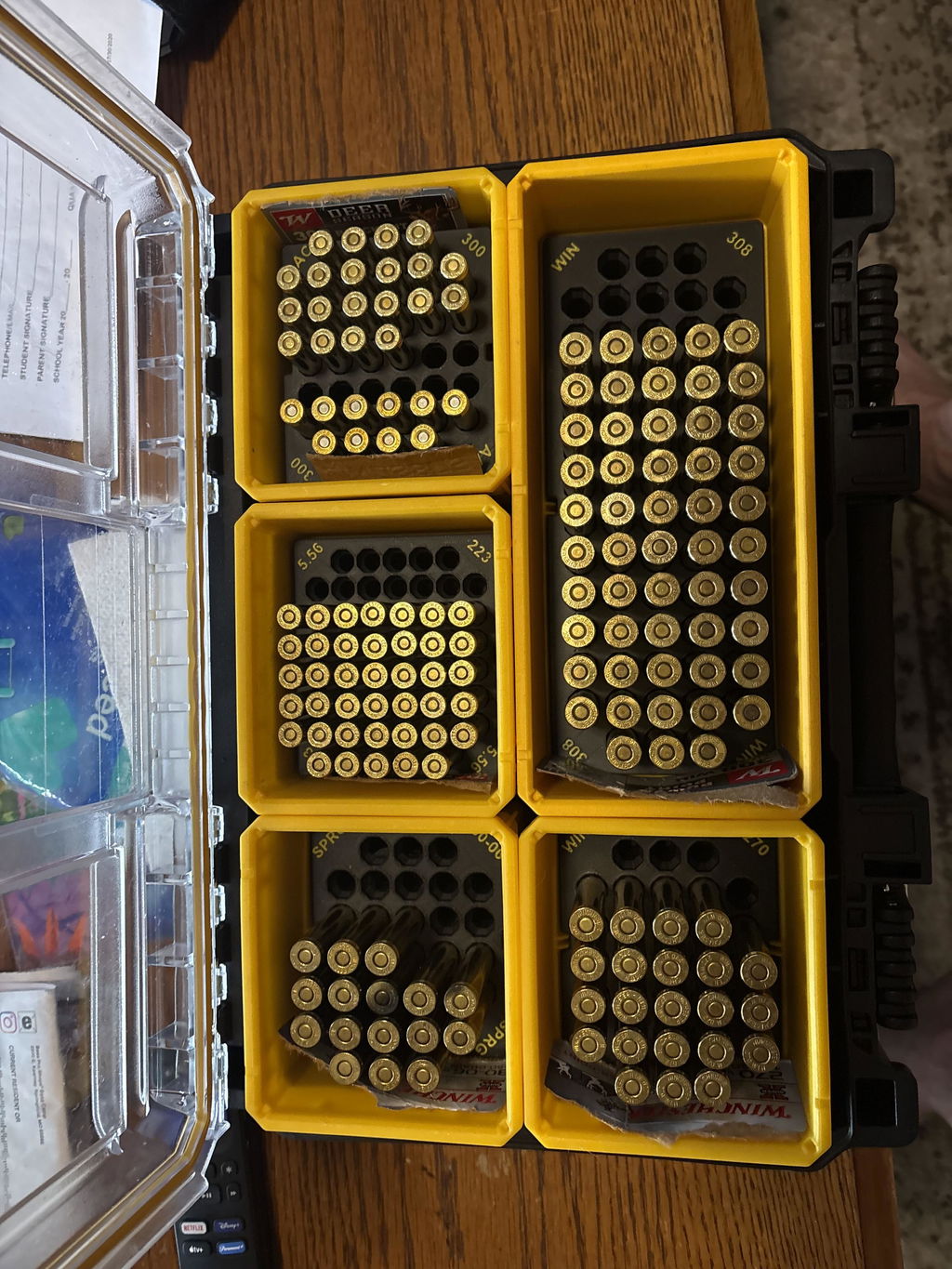
For a Milwaukee Packout, DeWalt case, Pelican-style protective case, or other mobile setup, select an insert engineered for the specific case dimensions. The organizer should prevent shifting while still providing enough clearance for die height and lock rings. A die that fits in an open tray may not fit in a closed case once lid clearance is considered.
This is where generic foam often falls short. Foam can be cut to hold nearly anything, but it may compress, tear, trap debris, and offer inconsistent support over time. A purpose-built PETG insert with defined pockets gives each die a repeatable location and makes inventory checks faster.
Look for Features That Improve Reloading Workflow
The organizer itself should do more than keep dies upright. The best layouts reduce setup time and make caliber changes more controlled.
Labels matter. At minimum, each pocket or position should be easy to identify by caliber, die type, or both. You do not need a complicated system, but you should be able to tell a .223 seating die from a .300 Blackout seating die without reading tiny engraving while leaning over the bench.
Spacing also matters. Closely packed dies save room, but too little finger clearance makes extraction clumsy, especially with larger lock rings. A well-designed organizer balances density with access. You should be able to lift a die out by hand without dragging its neighbor along with it.
Finally, think about supporting parts. Shellholders, spare decapping assemblies, Allen wrenches, die bushings, and caliber-specific gauges tend to become loose bench clutter. An organizer with a nearby compartment for those small components keeps the die set complete and ready for the next session.
Common Fit Mistakes to Avoid
The most common mistake is buying based on a broad claim such as “fits reloading dies.” That description may mean the product accepts a bare 7/8-inch cylinder, not a complete Hornady die with a lock ring and bushing installed.
Another mistake is choosing a holder based only on the number of slots. A 12-slot tray is not useful if the pockets are too shallow, too narrow, or incompatible with your storage case. Verify pocket dimensions, overall insert dimensions, and closed-lid clearance when applicable.
Avoid mixing dies from several calibers into unlabeled universal pockets unless you have a simple, consistent identification system. Similar-looking dies are easy to confuse, and reloading organization should remove uncertainty rather than create it.
For reloaders building a cleaner bench or a protected mobile setup, WM Prints-style precision-fit storage is the right standard to look for: defined positions, durable material, platform-specific dimensions, and room for the configuration you actually run.
The organizer that fits Hornady dies best is the one that holds your complete, adjusted die setup without pressure on the lock ring or bushing, keeps related parts together, and fits the way you move from storage to press. Get those three details right, and your die collection stops being loose hardware and becomes a dependable part of the loading workflow.